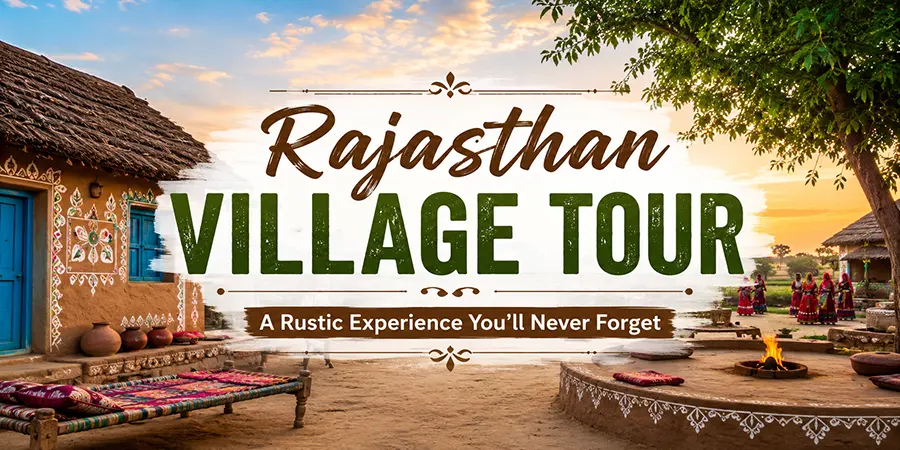
Rajasthan Village Tour: A Rustic Experience You’ll Never Forget
A Rajasthan Village Tour begins the moment you leave the highway behind and the road turns to dust — that’s when Rajasthan finally shows you its real face. Not the one on postcards, with turrets and moats, but the quieter one: a woman grinding masala on a stone slab, a potter’s wheel still wobbling from the last pull, a kettle of chai passed around a courtyard because a stranger just walked in and, in a village, a stranger is simply a guest who hasn’t had tea yet.
I have seen first-time visitors step out of an air-conditioned car near Salawas or Chandelao and quieten for a minute. It was not what they expected. And that’s the whole point.
Why a Rajasthan Village Tour Feels Different From Regular Sightseeing
Forts tell you what Rajasthan was. Villages show you what Rajasthan is, right now, this evening, over dinner.
City itineraries move fast — fort, lunch, bazaar, next fort. A village visit moves at the pace of the village itself. Nobody’s rushing you past the loom. The weaver will explain the pattern if you ask, and probably tell you a story about his grandfather too.
This is also where Rajasthan’s craft traditions actually live. According to Rajasthan’s Department of Tourism, the state is home to over 30 recognised craft clusters — block printing in Bagru, blue pottery near Jaipur, leather juttis in Jodhpur villages, and tie-dye bandhej in Shekhawati towns. You won’t find the real depth of these crafts in a city emporium. You find it at the source.
Villages Worth Actually Visiting (Not Just Listed)
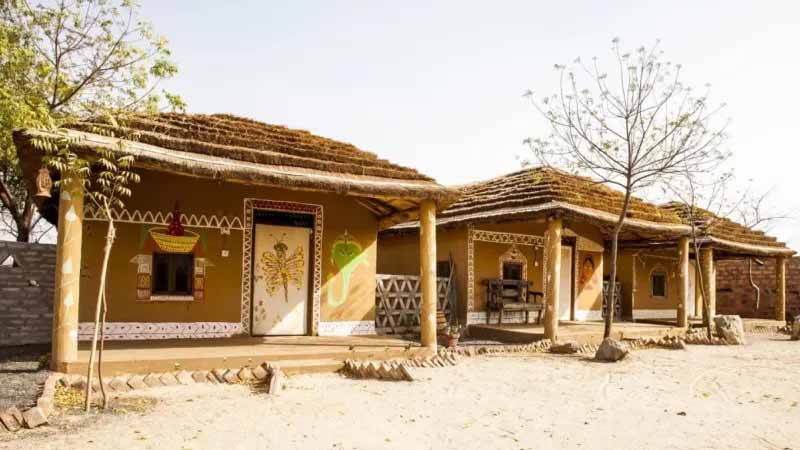
Bishnoi villages, near Jodhpur — The Bishnoi community has practised strict environmental conservation for over 500 years; this is where the Khejarli tree massacre of 1730 happened, when hundreds gave their lives protecting trees. Visiting here isn’t just sightseeing — it’s meeting India’s original conservationists, and their black buck and chinkara herds still roam freely because of them.
Chandelao, near Jodhpur — A small, restored village with one heritage haveli-turned-homestay. Good for travellers who want one quiet night rather than a packed itinerary.
Samode and Nawalgarh, Shekhawati region — Famous for painted havelis with frescoes that predate modern advertising by two centuries — literally, since traders once used these wall paintings to showcase their wealth and travels.
Salawas, near Jodhpur — Known for durrie (rug) weaving. Watching a durrie take shape on a pit loom, thread by thread, changes how you look at the one on your own living room floor.
Rohet and Nimaj, Pali district — Rural stretches where jeep safaris cut through farmland and open scrub, good for travellers who want landscape as much as culture.
None of these are far-flung — most sit within 30-60 minutes of Jodhpur, Jaipur, or Udaipur, so you don’t need a dedicated 10-day trip to experience one properly. Even a half-day detour works.
What Village Life Actually Involves (Practical, Not Poetic)
Here’s what most blogs skip — the actual logistics.
- Best time to go: October to March. Summer village visits (April-June) are brutally hot, often 42°C+, and many outdoor craft demonstrations pause during peak heat.
- Typical costs: A guided half-day village tour from Jodhpur or Jaipur usually runs ₹1,500-3,500 per person depending on group size and whether transport is included. Overnight village homestays range roughly ₹2,500-6,000 per night, meals included, though prices shift by season and property.
- What to wear: Modest, breathable cotton. Villages are conservative; shoulders and knees covered goes a long way, for both comfort and respect.
- Photography: Always ask before photographing people, especially women and children. Most villagers are warm about it once asked — the asking itself matters.
- Cash: Carry small denominations. Many village artisans and small homestays don’t accept cards.
A Rajasthan Village Tour Isn’t Just for “Culture Lovers”
That’s a myth worth busting. Families travel well here because kids genuinely enjoy bullock cart rides and feeding camels more than they enjoy another fort audio guide. Photographers get golden-hour light on mud homes that no city location matches. Even business travellers doing a quick Jaipur trip can fit in a half-day Bagru or Sanganer detour between meetings.
Responsible Travel: The Part Competitors Skip
A village isn’t a movie set. It’s someone’s home. A good Rajasthan Village Tour operator will:
- Route a fair share of your spend directly to the artisan or family, not just the middleman
- Cap group sizes so a household isn’t overwhelmed by tourists
- Brief you on local customs before you arrive, not after you’ve made an awkward mistake
If an operator can’t explain where your money goes, that’s a fair question to ask before booking.
How to Plan Yours
- Decide your base city — Jodhpur and Jaipur have the easiest village access.
- Pick a focus: craft, wildlife-conservation culture (Bishnoi), or architecture (Shekhawati).
- Choose half-day, full-day, or overnight based on how deep you want to go.
- Book with an operator who arranges the household visit in advance — turning up unannounced isn’t fair to the family.
Final Thought
A fort will still be standing next year, and the year after. A village conversation over chai, an old craftsman’s hands moving on a wheel he’s used for forty years — that moment is only there once. That’s really the difference a Rajasthan Village Tour offers: not a monument, but a memory that belongs to a real person’s everyday life, one you were lucky enough to be let into for an afternoon.
Note: Prices and travel conditions can change seasonally — confirm current rates and village access with your travel operator before booking.