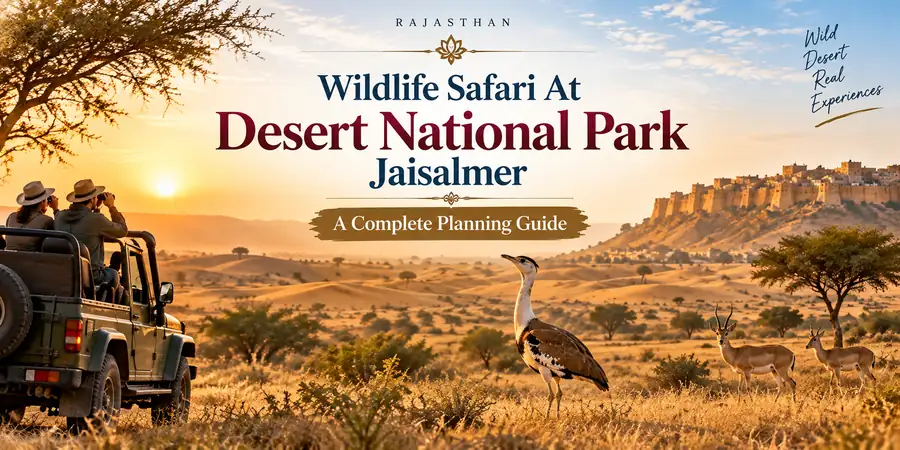
Wildlife Safari At Desert National Park Jaisalmer: A Complete Planning Guide
A wildlife safari at Desert National Park in Jaisalmer takes you into one of India’s largest protected areas — 3,162 sq km of sand dunes, salt lakes and rocky scrubland that shelters the critically endangered Great Indian Bustard along with chinkara, desert fox, blackbuck and over 200 bird species. Unlike the forest safaris of Ranthambore or Sariska, this is an open, low-vegetation landscape, so animals are often visible from a good distance if you time your visit right.
This guide covers what you’ll actually see, how to book the safari, realistic costs, the best time to go, and mistakes that trip up first-time visitors.
Where Is Desert National Park and How Far Is It From Jaisalmer City
The park lies about 40–45 km southwest of Jaisalmer, near the Myajlar road, and takes roughly 45–60 minutes to reach by road. Most travellers base themselves in Jaisalmer city or in Khuri village, which sits right on the park’s edge and works out to be a quieter, less crowded alternative to the busier Sam sand dunes area.
If you’re combining the safari with forts, havelis and the Sam dunes, it’s worth checking full Jaisalmer tour packages that bundle transport, permits and accommodation together — this saves a fair bit of back-and-forth arranging each piece separately, especially if you’re travelling with family or on a tight schedule.
What Wildlife You Can Actually See
The desert looks empty at first glance, but the low scrub and open sightlines make spotting easier than in a dense forest, provided you go at the right hour.
Mammals:
- Chinkara (Indian gazelle) — the most commonly sighted animal, often in small herds
- Blackbuck — less frequent inside the core park than chinkara
- Desert fox and Bengal fox
- Desert cat — elusive, mostly nocturnal
Birds:
- Great Indian Bustard — the park’s flagship species and one of the heaviest flying birds in the world; sightings are not guaranteed and depend on season and luck
- Migratory raptors between November and February: Eastern Imperial Eagle, Himalayan and Eurasian Griffon vultures, Saker Falcon
- Resident birds: sandgrouse, larks, and various desert-adapted species
Reptiles: spiny-tailed lizards, desert monitors, and a few snake species including saw-scaled viper — your guide will point these out rather than you stumbling on them.
The park is also geologically interesting: fossilised wood in parts of the reserve is estimated to be around 180 million years old, a reminder that this stretch of Thar was once far wetter than it is today.
Best Time For The Safari
Early morning, between roughly 6:30 AM and 9:00 AM, gives the best combination of active birdlife and cooler temperatures. Late afternoon, around 4:00–5:00 PM, is the second-best window. Midday heat pushes most wildlife into hiding, so a noon safari is largely a scenic drive rather than a wildlife one.
Seasonally, November to February is the strongest window — this overlaps with the migratory bird season and comfortable daytime temperatures. March through June gets progressively hotter, and while the park is technically open year-round, summer safaris are tough on both visitors and animals.
Permits, Entry Fees and Safari Costs
You need a Forest Department permit to enter the core wildlife zone. This is usually arranged by your safari operator or homestay in Khuri using a valid ID, so you rarely need to queue at a forest office yourself.
| Item | Approximate Cost |
|---|---|
| Entry fee (Indian nationals) | ₹50–₹100 per person |
| Entry fee (foreign nationals) | ₹300 |
| Guide fee | ₹200 |
| Jeep safari (per vehicle, shared or private) | ₹2,000–₹5,000 |
These are indicative ranges pulled from current park and tour-operator listings — actual rates shift with season, vehicle type and whether you book a private or shared jeep, so confirm the exact figure at the time of booking rather than treating this as fixed pricing.
A simple way to estimate your group’s cost: Total safari cost ≈ (entry fee × number of people) + guide fee + jeep rental
For a family of four in peak season, that typically lands somewhere between ₹2,500 and ₹5,500 for the full outing, guide and jeep included.
How the Safari Actually Works
Most safaris run along a fixed 12-km trail inside the park, with a registered guide accompanying every vehicle — this isn’t optional, and it’s also what keeps sightings safe for both visitors and animals. A typical outing lasts about 2–3 hours: a slow jeep crawl through dune and scrub terrain, periodic stops for birdwatching, and a final stretch where guides use radio or local knowledge to check where bustards or blackbuck have last been seen.
A 4×4 open jeep is the standard vehicle, since it copes better with soft sand than a regular car and gives an unobstructed view for photography.
Common Mistakes First-Time Visitors Make
- Booking a midday slot expecting Ranthambore-style sightings — the heat empties the landscape by 10 AM.
- Skipping binoculars — many species, especially raptors and the bustard, are spotted at distance, not up close.
- Assuming the park is like a forest safari — there’s no thick tree cover, so orient your expectations toward open-landscape spotting rather than sudden close encounters.
- Not carrying warm layers for winter mornings — Thar Desert dawns in December and January can dip close to freezing, even though afternoons are pleasantly warm.
- Booking without confirming the permit is included — some budget operators quote a jeep price that excludes the Forest Department entry fee, which comes as a surprise at the gate.
Who Should Prioritise This Safari (And Who Can Skip It)
This safari suits birdwatchers, photographers, and travellers who want a genuinely different Rajasthan experience beyond forts and dune-bashing. If you’re specifically chasing big-cat sightings, this isn’t the park for that — there are no tigers or leopards here, and the appeal is the desert ecosystem itself rather than predator encounters.
For travellers building a longer Rajasthan itinerary, it’s usually easiest to fold this safari into a broader Jaisalmer stay rather than treating it as a separate trip. Several operators offering Jaisalmer tour packages include the Desert National Park safari alongside fort visits and a Sam dunes evening, which works out more efficient than arranging each activity independently.
FAQs
Is a jeep safari the only way to explore Desert National Park? No. Guided walking treks and camel safaris are also available, though jeep safaris cover more ground and are the most common choice for wildlife spotting.
Can I see the Great Indian Bustard on every visit? No. It’s a critically endangered species with a small, shy population, so sightings depend on season, luck and your guide’s tracking. Winter months offer better odds.
Is Desert National Park safe for solo travellers? Yes, as long as you go with a registered guide and operator, which is mandatory in any case for entry to the core zone.
How is this different from the Sam sand dunes experience? Sam dunes are mainly about the dune landscape, camel rides and cultural evenings. Desert National Park is a protected wildlife zone focused on birdwatching and animal spotting, with a quieter, more remote feel.
The Practical Takeaway
Book an early-morning or late-afternoon slot, confirm your permit and guide fee are included in the quoted price, and carry binoculars plus warm layers if you’re visiting between November and February. Treat sightings of the Great Indian Bustard as a bonus rather than a guarantee, and you’ll come away with a genuinely different picture of Rajasthan than the fort-and-dune circuit alone provides.