Mandawa Travel Guide: Planning Your Visit to Rajasthan’s Painted Town
This Mandawa travel guide covers what you need before you go: how to reach the town, which havelis are worth your time, what things cost, and how many days to set aside. Mandawa sits in Rajasthan’s Shekhawati region and is known for its painted havelis — old merchant mansions covered in frescoes. It’s compact enough to see on foot, which makes planning simpler than it looks.
Where Is Mandawa and How Do You Get There
Mandawa is in the Jhunjhunu district of Shekhawati, roughly 180 km from Jaipur and about 260 km from Delhi. There’s no airport or railway station in the town itself — the nearest railhead is Jhunjhunu, about 30 km away.
Most visitors arrive by road:
- From Jaipur: Around 3.5–4 hours by car (167–180 km).
- From Delhi: Around 5–6 hours by car (260 km).
- From Bikaner: Slightly shorter, closer to 3.5 hours.
A hired car with driver is the easiest option, since bus timings can be inconvenient and don’t drop you close to the haveli lanes. Buses from Jaipur and Delhi work if budget matters more than comfort.
Best Time to Visit Mandawa
October to March is the practical window. Days are warm and pleasant, nights turn cool enough for a light jacket, and walking between havelis in the afternoon sun doesn’t wear you out. Between April and June, daytime temperatures regularly cross 40°C, and the narrow lanes offer little shade — this is the season to avoid unless you’re planning very early morning or late evening walks only.
How Many Days You Actually Need
One full day covers the core havelis and the fort at a comfortable pace. Two days give you room for a camel cart ride, a slower photography walk during golden hour, and a side trip to a nearby Shekhawati town. Beyond two days, most travellers find themselves repeating the same kind of sight — Mandawa rewards a focused visit rather than a long stay.
Things to Do in Mandawa
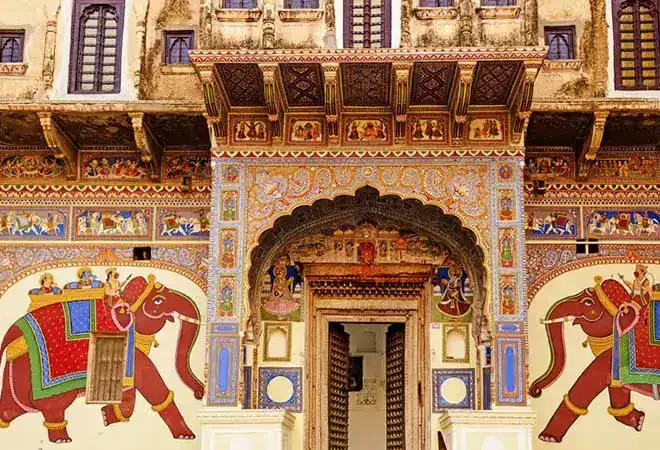
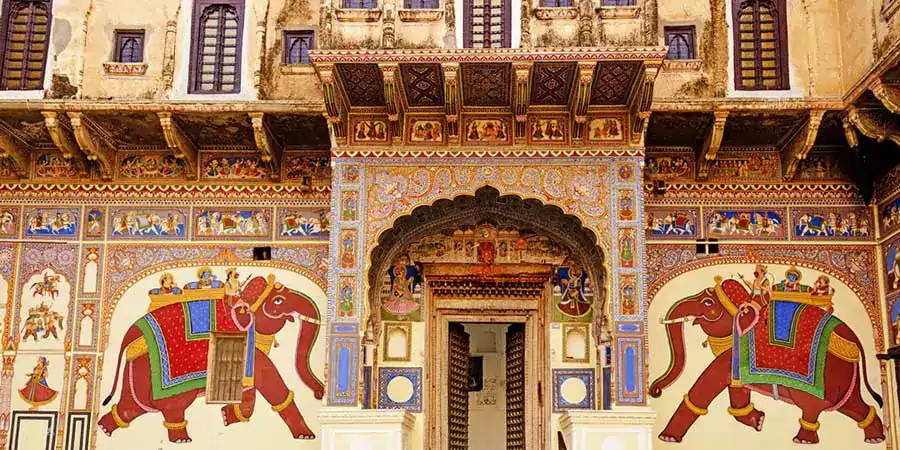
Haveli walk. The main reason people visit. Hanuman Prasad Goenka Haveli, Jhunjhunwala Haveli, Murmuria Haveli, and Gulab Rai Ladia Haveli are among the most recommended, each with a distinct fresco style — mythological scenes, colonial-era figures, even early depictions of trains and aeroplanes painted by artists who’d only heard them described.
Mandawa Fort. Built in the 18th century by Thakur Nawal Singh, it now functions as a heritage hotel. Non-guests can usually walk through parts of it to see the mirror work and courtyard.
Harlalka Baoli. A 200-foot stepwell near Harlalka Haveli — worth a stop if you’re already in that lane, not a destination on its own.
Camel cart ride. A short, relaxed way to see the town’s edges, usually arranged through your hotel.
Hiring a Local Guide in Mandawa
A guide genuinely changes the experience here, because many frescoes reference specific historical events or family stories that aren’t obvious from the painting alone. Guide charges typically range from about ₹500 for a half day to ₹1,200 for a full day covering Mandawa and nearby villages. It’s worth asking your hotel to recommend someone rather than hiring the first person who approaches you at a haveli entrance.
What It Costs to Visit
Most havelis in Mandawa are privately owned and looked after by a caretaker rather than run as ticketed monuments. Entry is usually a small negotiated fee rather than a fixed rate.
| Expense | Approximate Range | Notes |
|---|---|---|
| Haveli entry | ₹100–150 per person, per haveli | Paid directly to the caretaker; no fixed ticket |
| Local guide | ₹500 (half day) – ₹1,200 (full day) | Covers Mandawa and nearby Shekhawati towns |
| Camel cart ride | Varies by duration | Usually arranged via hotel |
| Budget hotel | Roughly ₹1,500–3,000/night | Simple guesthouses |
| Heritage haveli hotel | ₹5,000+/night | Restored havelis converted into hotels |
A rough day budget for two people, including three haveli entries, a guide, and meals, works out to somewhere between ₹2,500 and ₹4,000, excluding accommodation — treat this as a planning estimate, not a quote.
Common Mistakes to Avoid
- Skipping a guide to save money. Without context, one haveli starts to look like the next. The fee is small relative to what it adds.
- Visiting in peak summer. The lack of shade in the lanes makes midday sightseeing genuinely uncomfortable from April onward.
- Treating Mandawa as a half-day stop. Rushing through means you see facades but miss the courtyards and interior frescoes, often the better-preserved ones.
- Not confirming haveli access in advance. A few havelis are only partly open, or closed if the caretaker is away — checking with your hotel that morning avoids a wasted walk.
Nearby Places Worth Combining With Mandawa
Mandawa works well as a base for the wider Shekhawati circuit: Nawalgarh for some of the region’s best-preserved havelis, Fatehpur for quieter, equally detailed frescoes, and Jhunjhunu for grander merchant mansions and better transport links. A day trip to one adds variety without changing hotels.
Mandawa Travel Guide: Frequently Asked Questions
Is one day enough for Mandawa? Yes, for the main havelis and the fort. Add a second day for a camel ride, a side trip, or a slower photography-focused visit.
Do I need to book haveli entry in advance? No. Entry is arranged on the spot with the caretaker at each haveli.
Is Mandawa suitable for a day trip from Jaipur? Possible but tight, given the 3.5–4 hour drive each way. An overnight stay is more comfortable and lets you catch the havelis in better light.
Is Mandawa safe for solo travellers? It’s a small, low-traffic town with a slower pace than major Rajasthan cities, which makes navigating on foot straightforward. Standard precautions — sharing your itinerary, avoiding empty lanes after dark — still apply.
Mandawa works best when you slow down for it: a full day at minimum, a guide who can read the frescoes, and one neighbouring Shekhawati town if your schedule allows.