Rajasthan for First-Time Visitors – Starter Guide 2026
Everything first-timers need for a Rajasthan trip: where to start, what to see, costs, and real tips.
Picture this. You step off your train at Jaipur Junction. The platform is bustling with cries of chai vendors, piles of marigold garlands on sale and somewhere in the distance, a pink fort perched on a hill as if it owned the whole sky. You haven’t even left the station, and Rajasthan has already started doing what it does best: pulling you in completely.
If this is your first time visiting Rajasthan, you’re about to experience one of India’s most layered, most alive, most visually overwhelming states. But “overwhelming” doesn’t have to mean confusing. This guide gives you everything you actually need — where to begin, what it will cost, how to move around, and the small things that make a big difference.
Quick Answer: Where Should First-Timers Start in Rajasthan?
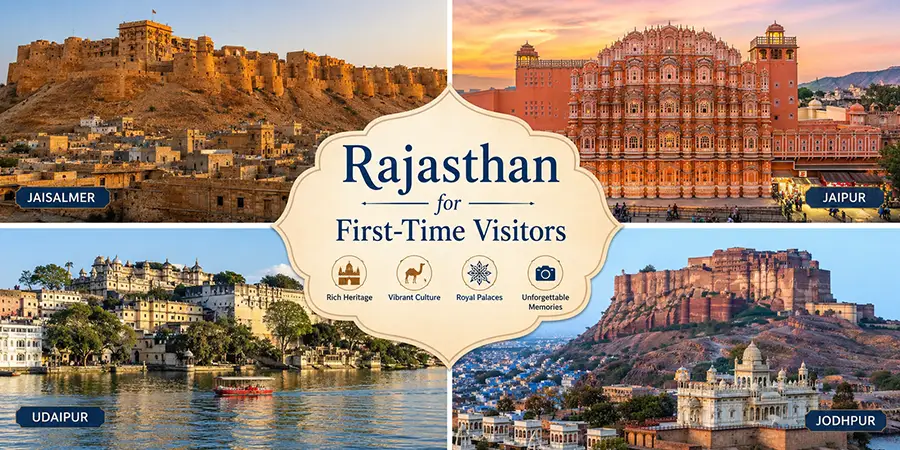
Start with the Golden Triangle of Rajasthan: Jaipur → Jodhpur → Udaipur.
This trio covers three completely different flavours of Rajasthan. Add Jaisalmer if you have more time. Seven to ten days is the sweet spot for a first trip.
Best Time to Visit Rajasthan
The window from October to March is when Rajasthan is at its best. Days are comfortable for walking, evenings are cool enough for rooftop dinners, and the festival season is in full swing.
- October–November: Post-monsoon green landscape, Pushkar Camel Fair (Nov), pleasant weather
- December–January: Peak season, slightly chilly nights — carry a light jacket
- February–March: Warm days, Jaisalmer Desert Festival (Feb), great for photography
April to June brings extreme heat — temperatures regularly cross 45°C in cities like Jaisalmer and Jodhpur. Not the best for first-timers unless you’re willing to plan your day around early mornings and evenings only.
Local tip from Udaipur: If you’re visiting in winter, pack a proper warm layer for nights. Rajasthan’s desert air turns genuinely cold after sunset — that thin shawl from your Delhi hotel won’t be enough.
The 4 Cities Every First-Timer Should Know
Jaipur – The Pink City (Start Here)
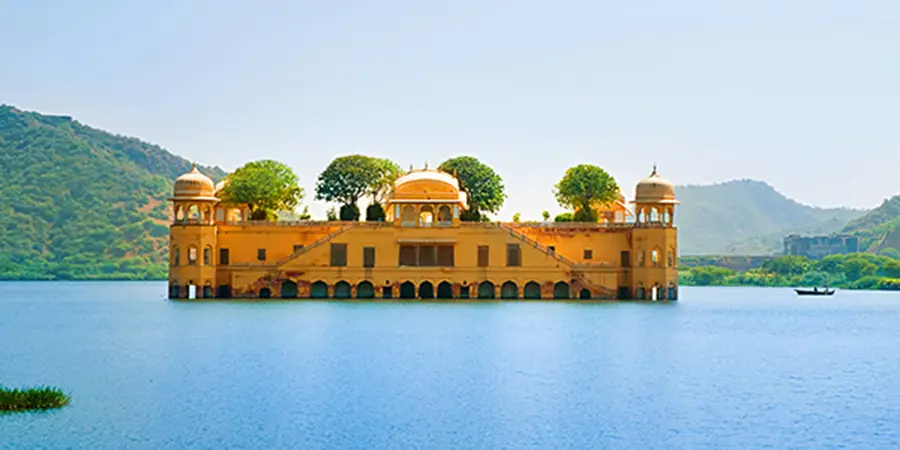
Jaipur is Rajasthan’s welcome mat. It’s the most connected city, easiest to navigate, and gives you the widest range of experiences in one place.
Must-see:
- Amber Fort — Entry: ₹200 (Indians) / ₹700 (foreigners). Go early, beat the crowds.
- Hawa Mahal — Entry: ₹50 (Indians) / ₹200 (foreigners). Best photographed from the tea stall across the road.
- Jantar Mantar (UNESCO) — Entry: ₹50 (Indians) / ₹200 (foreigners). More fascinating than it looks.
- City Palace — Still home to the royal family. Entry fees vary; composite tickets often available.
Jaipur composite ticket covers 7 monuments for around ₹1,000 (for foreigners) — worth it if you’re covering multiple sites in a day.
Days needed: 2–3 days minimum.
Jodhpur – The Blue City

Nothing prepares you for Mehrangarh Fort. It rises from a 125-metre-high rock, visible from across the city. And when you stand on the ramparts and look down at the ocean of blue-painted houses below — that view stays with you.
Must-see:
- Mehrangarh Fort — One of India’s most impressive forts. Entry fees include an audio guide. Budget around ₹600–700 (Indians), more for foreigners.
- Jaswant Thada — A white marble cenotaph, quiet and beautiful, right next to the fort.
- Sardar Market & Clock Tower — For street shopping and mirchi vada (fried chilli snacks you’ll think about for days).
Days needed: 1–2 days.
Jaisalmer – The Golden City
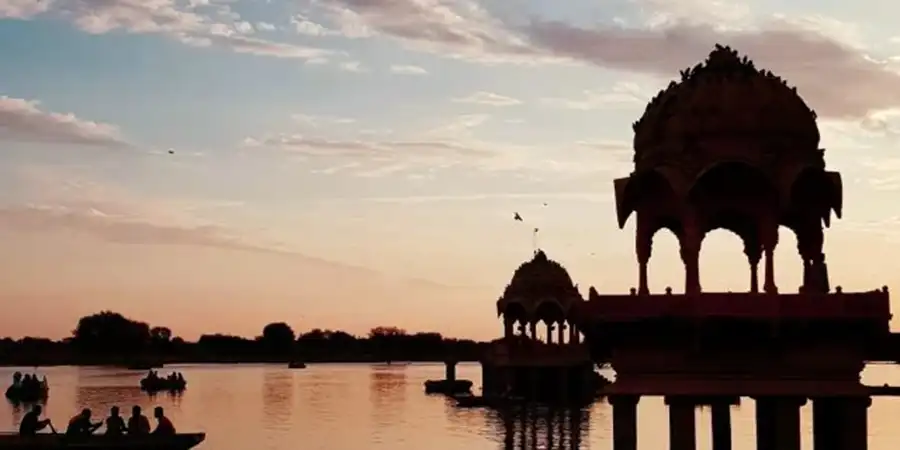
Jaisalmer is unlike any other place in India. An entire living fort-city, golden sandstone as far as you can see, and the Thar Desert beginning right at the city’s edge.
Must-see:
- Jaisalmer Fort — One of the world’s few living forts; people still live inside. Entry: ₹70 (Indians) / ₹150 (foreigners).
- Sam Sand Dunes — 45 km from the city. Camel safaris start at ₹300–500 per person. Desert camps for an overnight stay cost ₹2,000–6,000+ depending on comfort level.
- Patwon Ki Haveli — Five interconnected mansions with extraordinarily detailed carvings.
Days needed: 2 days (include one overnight dune camp if possible).
Udaipur – The City of Lakes
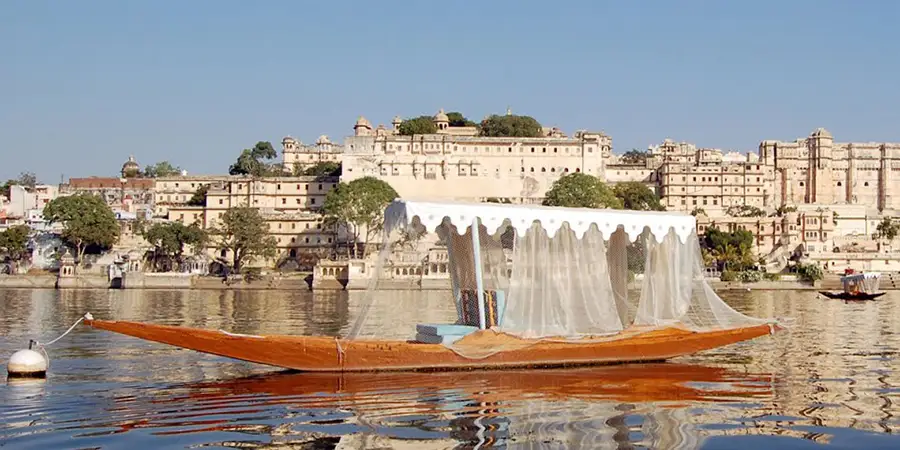
If Jaipur is the energy of Rajasthan, Udaipur is the soul. Surrounded by Lake Pichola, with white palaces mirrored in the water, and the Aravalli hills behind — it’s Rajasthan at its most romantic, most unhurried.
Must-see:
- City Palace — The largest palace complex in Rajasthan. Entry: ₹300 (Indians) / ₹600 (foreigners).
- Boat ride on Lake Pichola — Sunset ride to Jag Mandir Island. Around ₹700–800 per person.
- Bagore Ki Haveli — Evening cultural show with folk dance at 7 PM is one of the best ₹90 you’ll spend.
- Sajjangarh (Monsoon Palace) — Hilltop sunset views over the city.
Days needed: 2–3 days. Udaipur is easy to fall in love with — most people end up staying longer than planned.
How to Move Between Cities
Rajasthan is large. Distances are real. Plan your route like a circuit, not a back-and-forth.
Logical first-timer route: Delhi → Jaipur → Jodhpur → Jaisalmer → Jodhpur → Udaipur → Delhi/Mumbai
Transport options:
- Train — Most comfortable and affordable between major cities. Book on IRCTC at least 2–4 weeks ahead during peak season. Jaipur to Jodhpur is roughly 5–6 hours; Jodhpur to Jaisalmer is about 5 hours.
- Private car with driver — The most flexible option, especially for families or small groups. Expect ₹12–20 per km depending on car type.
- RSRTC Volvo buses — Decent option between major cities. Book at counters or online.
First-timer mistake to avoid: Trying to cover Jaipur, Jodhpur, Jaisalmer, AND Udaipur in 5 days. The travel time alone will exhaust you. Choose 3 cities and do them well.
Budget Breakdown for First-Timers
Here’s a realistic daily estimate per person:
| Category | Budget Travel | Mid-Range | Comfortable |
|---|---|---|---|
| Stay | ₹1000–1,200 | ₹2,500–4,000 | ₹5,500–12,000+ |
| Food (3 meals) | ₹300–500 | ₹700–1,200 | ₹1,500+ |
| Sightseeing | ₹200–400 | ₹500–800 | ₹1,000+ |
| Transport (local) | ₹200–400 | ₹500–1,000 | ₹1,500+ |
Heritage havelis and palace hotels are Rajasthan’s speciality — staying in a converted haveli in Jodhpur’s old city or a heritage property in Udaipur is an experience in itself, not just accommodation.
If you are looking for Budget Travel Guide : Know more about Rajasthan Tour Packages Under 10000
What to Eat: Don’t Leave Without Trying These
Rajasthani food is built for the desert — rich, spiced, and deeply satisfying.
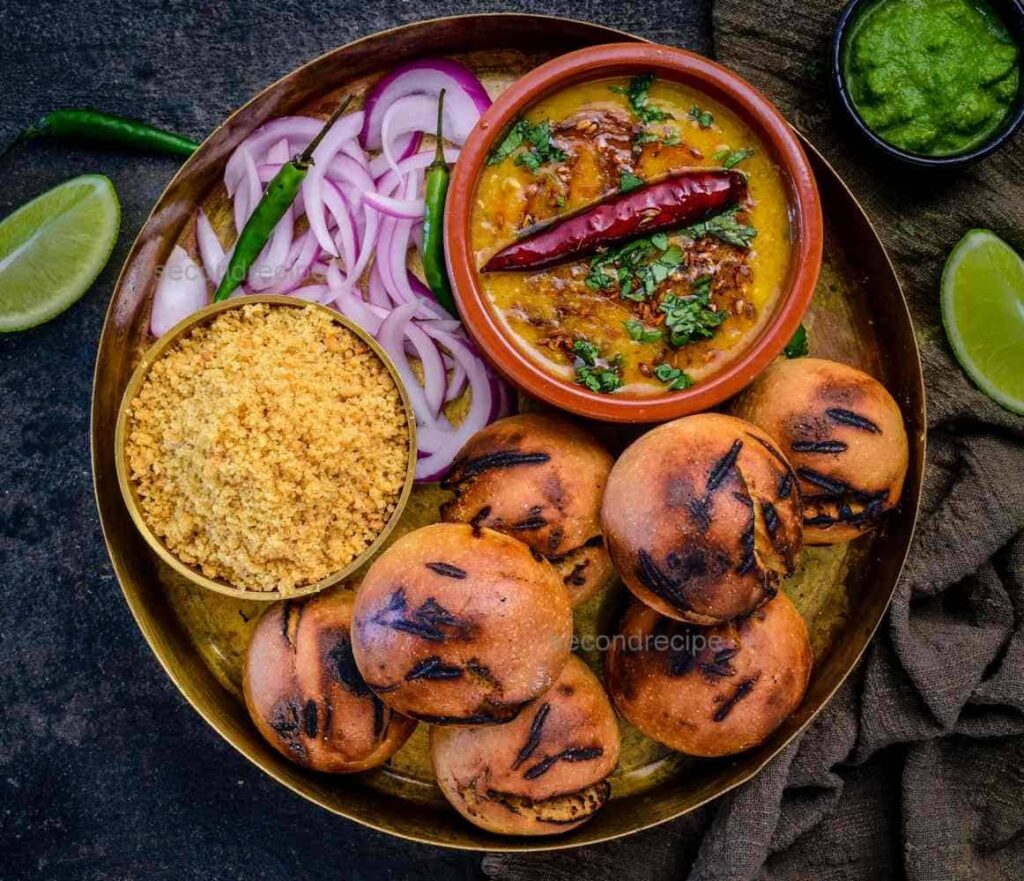
- Dal Baati Churma — The definitive Rajasthani dish. Baked wheat balls with lentil curry and sweet crumbled bread. Order it everywhere.
- Laal Maas — Fiery red mutton curry. Not for the spice-averse.
- Gatte ki Sabzi — Chickpea flour dumplings in yoghurt gravy. Try it at a local thali place.
- Pyaaz Kachori (Jodhpur) and Mawa Kachori (Jodhpur) — Street food stops that justify planning your whole day around.
- Ghewar — Disc-shaped sweet, especially good during festivals.
For food safety, eat at places with visible turnover — fresh food, busy tables, active kitchens. Rajasthan’s local thali spots are usually your best bet.
6 Things Nobody Tells
- Dress in layers in winter. Days can hit 22–25°C; nights drop to single digits in December-January. Jaisalmer especially gets cold at night despite being a desert.
- Carry cash to smaller sites. Many smaller monuments, local auto drivers, and markets won’t accept UPI or cards. Keep ₹500–1,000 cash available.
- Haggle gently, not aggressively. Rajasthan’s markets are famous for block prints, blue pottery, leheriya fabrics, and silver jewellery. Bargaining is expected but keep it respectful.
- Book desert camps early. Good quality camps near Sam Dunes get fully booked weeks ahead in peak season (Nov–Feb).
- Respect temple dress codes. Cover your shoulders and knees at temples. Many temples provide cloth wraps at the entrance — use them.
- The forts are bigger than they look. Wear comfortable walking shoes. Mehrangarh, Amber, Chittorgarh — these require serious walking. Don’t underestimate the staircases.
FAQ – Rajasthan for First-Time Visitors
How many days is enough for a first trip to Rajasthan? Seven to ten days is ideal for covering 3–4 cities comfortably. A week is the minimum to avoid feeling rushed.
Is Rajasthan safe for solo travellers? Yes, particularly Jaipur, Udaipur, and Pushkar, which are well-established tourist circuits. Use standard travel precautions, especially at night in less-visited areas.
What is the entry fee for Amber Fort? Around ₹200–₹300 for Indian adults and ₹700 for foreign nationals (as of 2025–26). Fees can be updated — confirm at the ticket counter or official Rajasthan Tourism website before your visit.
Can I visit Rajasthan on a budget? Absolutely. Rajasthan has excellent budget options — RTDC guesthouses, Zostel hostels, and local guesthouses in old city areas are all good choices. You can have a full, meaningful experience for ₹1,500–2,000 per day all-in.
What should I not miss as a first-timer? The sunset view from Mehrangarh’s ramparts in Jodhpur, a boat ride on Lake Pichola in Udaipur, and sleeping under stars at a Jaisalmer desert camp. These three are genuinely unforgettable.
Do I need to pre-book tickets for monuments? Major forts like Amber accept online bookings and it’s recommended during peak season weekends. Others are walk-in. Online booking saves queue time significantly.
Rajasthan doesn’t reveal itself in a single visit. But a first trip done right — unhurried, curious, open to the detours — will leave you with more than photographs. It’ll leave you with the kind of stories you tell for years. Start with the three cities, follow the route, eat everything, and let the forts do the rest.
Always verify current entry fees and hotel rates before your trip, as prices may change seasonally.